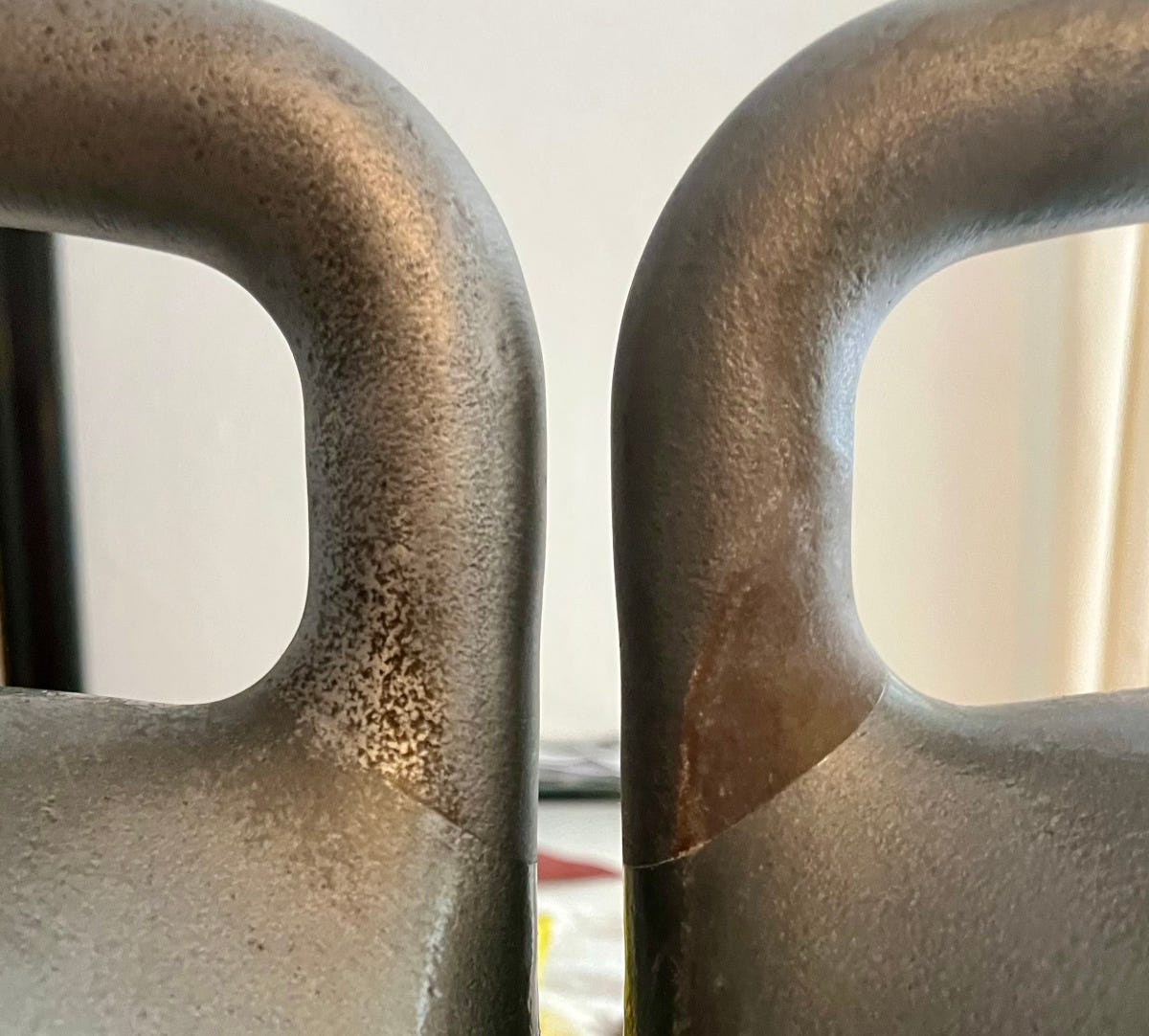
Spring cleaning for the kettlebell? Not exactly, though it looks like I’ll need to do it again soon. This post is from last autumn. All winter long, the climate in my home gym was such that I could probably have gotten through full 10-minute competition sets without chalk. But recently, when ramping up intensity, I realized that times are coming again when chalk will be necessary – at least for the snatch. So I always practiced the grip with chalk, even if sparingly, to train right away with maximum friction. Since hand sweat, along with air humidity, causes flash rust – which is why I’m mentioning it here. I had also once made the mistake of wiping it down with a damp cloth after a workout. Now I do wipe it after every session, but always only with a dry towel.
Now for the actual report:
I’ve mentioned it before – even with a premium Pro-Kettlebell, a little surface rust is unavoidable. I looked around to see how others handle this. Most tips were purely mechanical – sanding – and there was also something about Sidol rust remover.
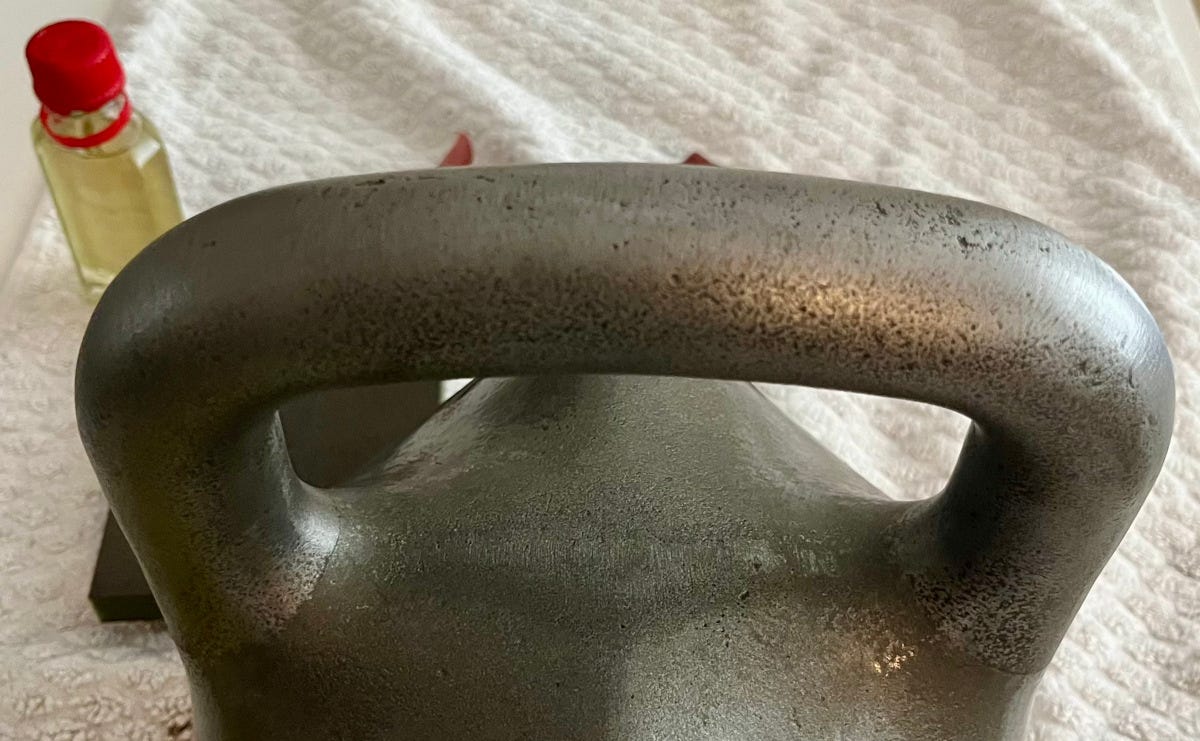
So off to the hardware store I went, picking up the items pictured, including Ballistol oil, which promises exactly what you’d hope for here. The sandpaper didn’t work out – it tears too quickly and doesn’t wrap well around the handle. The scouring sponge (no-name brand), on the other hand, was excellent. The handle was back to bare metal in no time – slightly less so in the recesses, but fine enough. It seems to be sufficient. Most importantly, you can hold it as shown and fold and pull it around the handle.
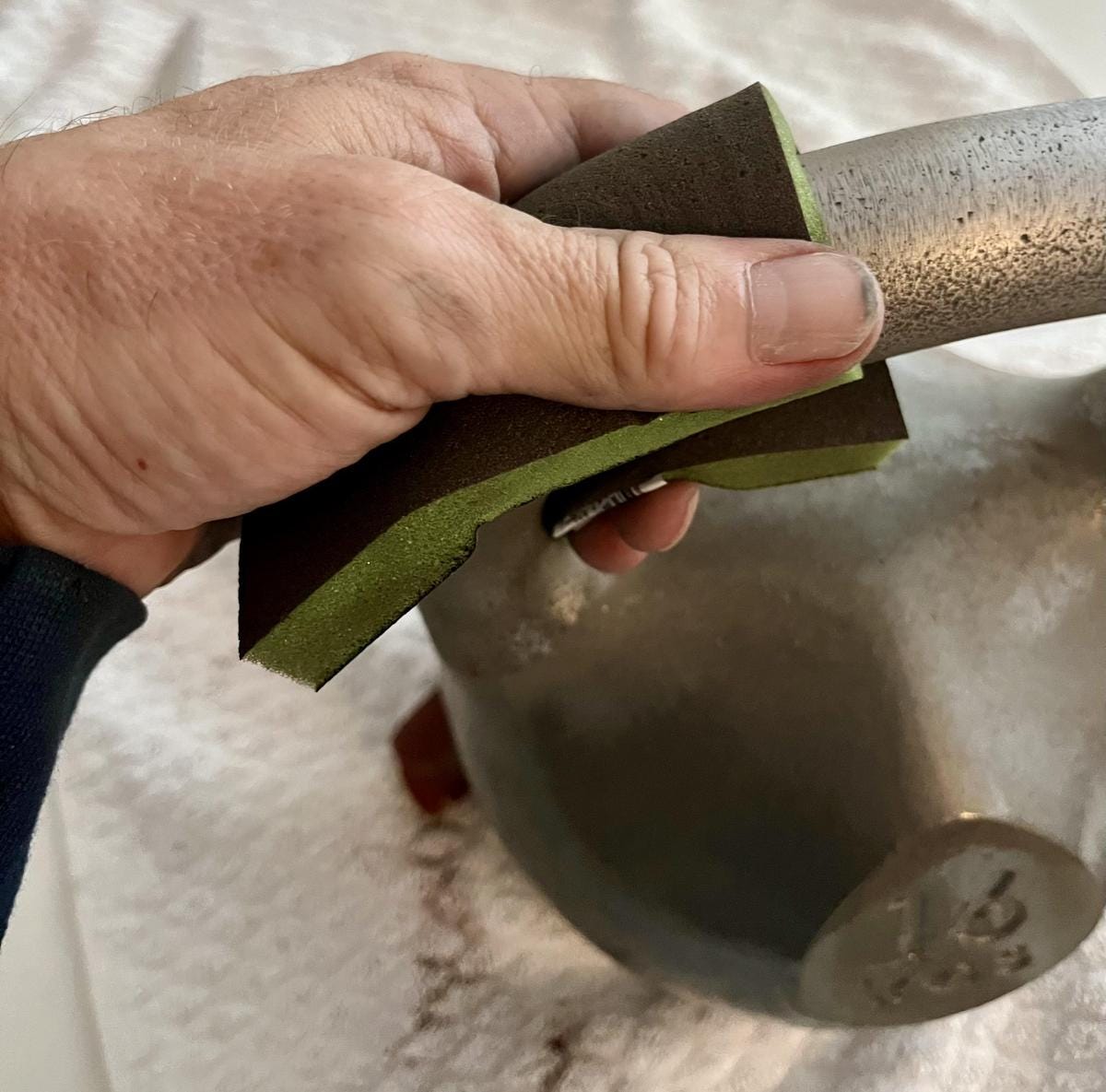
The process produces a rather unpleasant dust, by the way. For subsequent rounds I dug out an old Covid mask (unused, naturally).
Now for the big Ballistol question. The manufacturer’s promise (translated from the German web page):
Ballistol on metal: Ballistol is used extensively in machine and tool manufacturing, in the production of precision instruments and scales. Ballistol forms an alkaline protective film on metals, neutralizes hand sweat and other acidic rust-promoting residues, and thus protects against corrosion. Due to its low surface tension and enormous creeping ability, Ballistol reaches even the tightest corners and finest cracks in metal. Ballistol is ideal for the care of precision and measuring instruments, scales and fine components.
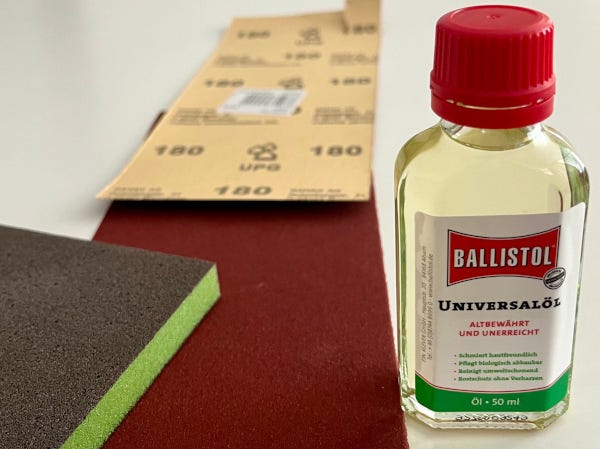
I was naturally skeptical about whether the oil film would make the handle too slippery. I took the plunge and rubbed down the handle, as well as the entire bell including the inside. Not sure whether the corrosion protection actually holds there. At minimum it polishes away the rust dust. Inside, the oil film might actually hold.
Yesterday’s workout was with the kettlebell treated this way – no problem at all. By the time I applied the first layer of chalk, the oil was gone. Combined with the rust dust though, a memorable smell arose during the process. But I kind of like that – there’s something old-school and hands-on about it.
Conclusion: Now I know how it’s done and that it’s a quick job. Just make sure to take a few precautions and use a surface that catches the dust.